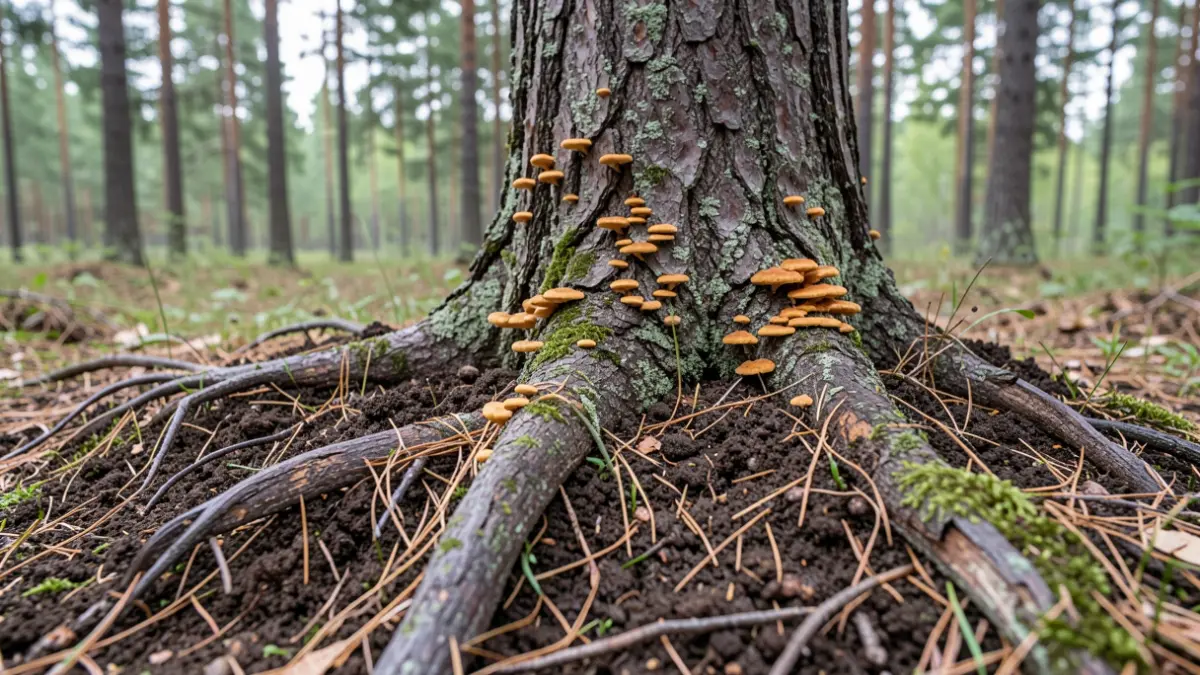
Luke's study investigated the occurrence of pine root rot in Northern Finland. The study included approximately 30 forest stands, three of which contained the fungus. The detected damage areas were small and local, with only a few pine trees killed or damaged by the fungus. Fungal spores were also found on the roots of dead junipers in two areas and on a birch stump.
Special researcher Juha Kaitera from Luke states that the possible occurrence of pine root rot in the north can be indicated by pines that have died strangely or have thinned crowns, as well as dead or brown junipers growing nearby. He emphasises, however, that similar symptoms can be caused by many other forest diseases. Pine root rot benefits from rising temperatures and is expected to spread further north with climate change.
Root rot fungi are the most serious damage-causing agents in boreal forests. Together with spruce root rot, pine root rot causes damage worth approximately 50 million euros annually. The fungus rots the tree's root system and can eventually kill the tree. The spread of the fungus can be prevented by avoiding felling during periods when the ground is thawed. In summer felling, fresh stump surfaces should be treated with urea solution or a biological grey oyster mushroom preparation.
Luke launched a two-year project in 2025 to investigate the occurrence of pine root rot in Northern Ostrobothnia and Southern Lapland. The project is funded by Luke, Metsä Group Treasury Oy, the ELY Centre for Northern Finland, Sallan yhteismetsä, and Stora Enso Oyj.